

County House
Dear visitors, the exposition of Trenčín Museum is currently CLOSED due to renovation. Thank you for your understanding and we look forward to seeing you in the other branches of the Trenčín Museum.
The exposition From the History And Culture of Privileged Trenčín Town and Quondam Trenčín County is on the first storey of the main edifice of the Museum of Trenčín (the so-called County House). This exposition is specialized in homeland science and consists of the nature-scientific, historical, art-historical, archeologic and ethnologic part. Our intention is not only to present rich history and culture of Trenčín region and the city itself, but also to integrate the Museum into the culture and art of the city.
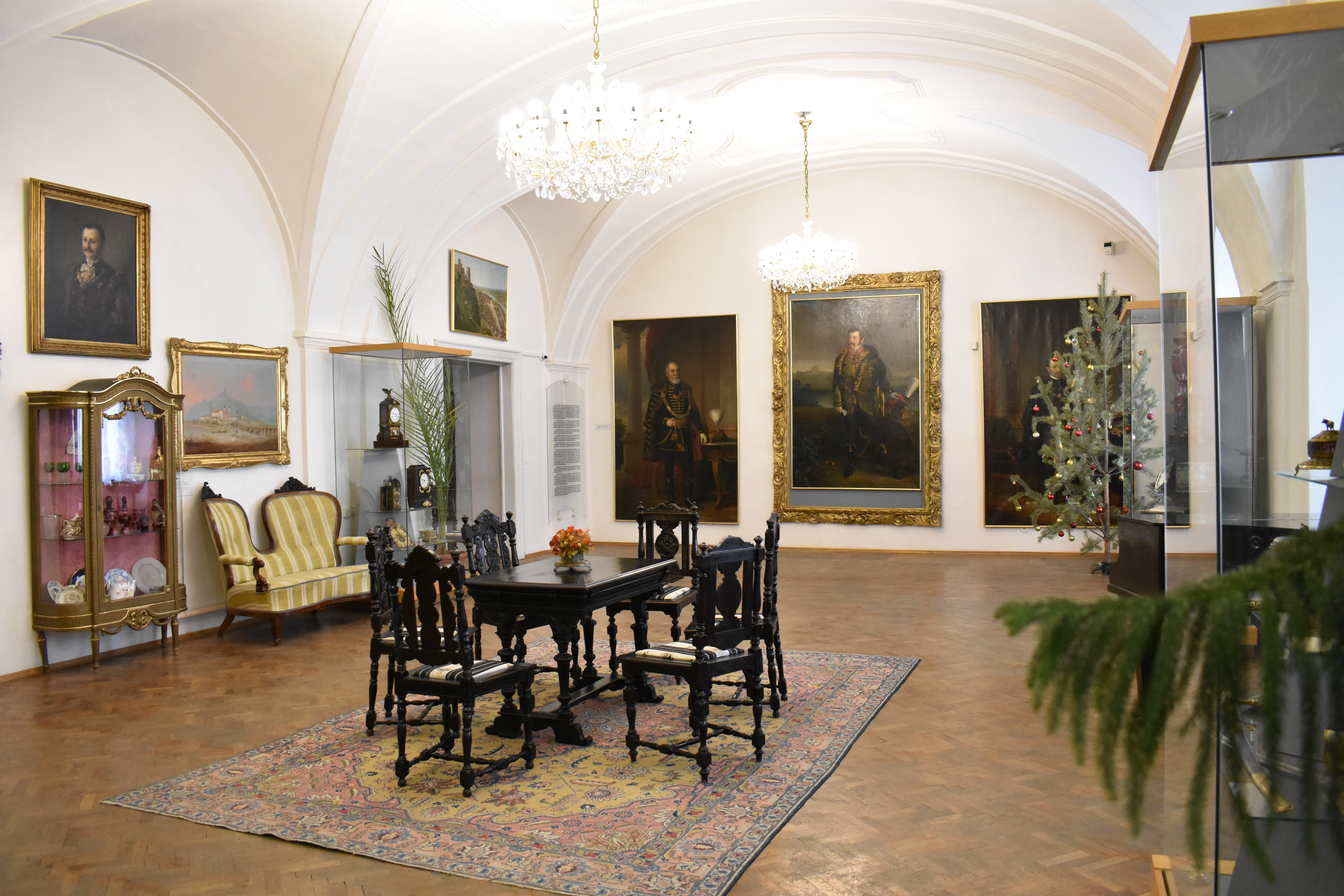
 In the largest room of the Museum (Congregation Hall) there are the exhibits of art and history of Trenčín. This room is also used for various cultural events and musical performances.
Visitors might be interested in the portraits of former countymen and subcountymen of Trenčín, painted in their life size. A lot of them were painted by excellent painters of their era, for example M. Barabás, an official portraitist of the supreme Austria-Hungarian nobility, as well as the court and county officers. A representative portrait of Matthew Csak (Matúš Čák) (by Spiš painter Teodor Boemm) belongs to the first-rate portraits of this powerful magnate. The Art Craft is, for instance, represented by a small but very nice collection of historical clocks (the oldest clock of the so-called lantern type is Baroque and comes from the 17th century). Bipartite tall vases, made of pink glass, engraved with a portrait decoration come from already nonexistent glass factory in Uhrovec (they were originally produced for a regional exhibition that took place in 1885 in Budapest).
We can also mention a Baroque majolica flowerpot from the Illeshazy manor house in Dubnica; Hutterite ceramics, tinny plates, fans or engraved pipes made of sea foam. Attention is paid to memorabilies from the inheritance of the pope Leo XIII. (1878 to 1903), who was a great ecclesiastical reformer. There are also adorned shoes, a little collar and a silken pileolus that the beatific pope Pius X. donated to the Trenčín Museal Company.
 The opening (nature-scientific) part of the exposition is dedicated to the history of the Nature-Scientific Union of Trenčín County that was found in 1877. The exposition is also devoted to doctor Karol Brančík, the founder and first supervisor of the Trenčín Museum. This section includes authentical items and things of natural character from Brančík´s large collection. It includes more than 700 exemplars of butterflies and another species of insect; written and photographic documentation, original drawings of insect and landscape motives from Brančík´s journeys.
In the archeological part visitors can see a lot of findings and and get to know archeologic localities of Trenčín region from the Primeval Age to the Early Middle Ages. One can see a stone instrument of a primeval man, crocks, urns, some bronze and copper weapons, instruments and jewels, products of the Laten Era, Roman discoveries, coins, grave equipment, Slavonic weapons and spurs of the Great Moravian riders.
In the last room, there is the ethnologic part of the exposition. A set of national costumes represents typical costumes of Trenčín surroundings. A significant part of the collection consists of glass-paintings and the set of folk wooden sacral plastics inspired by a favourite themes of God´s Mother. There are also typical pieties and a rare corpus of Jesus Christ being crucified. The collection is enriched with two carved beehives in bigger sizes.