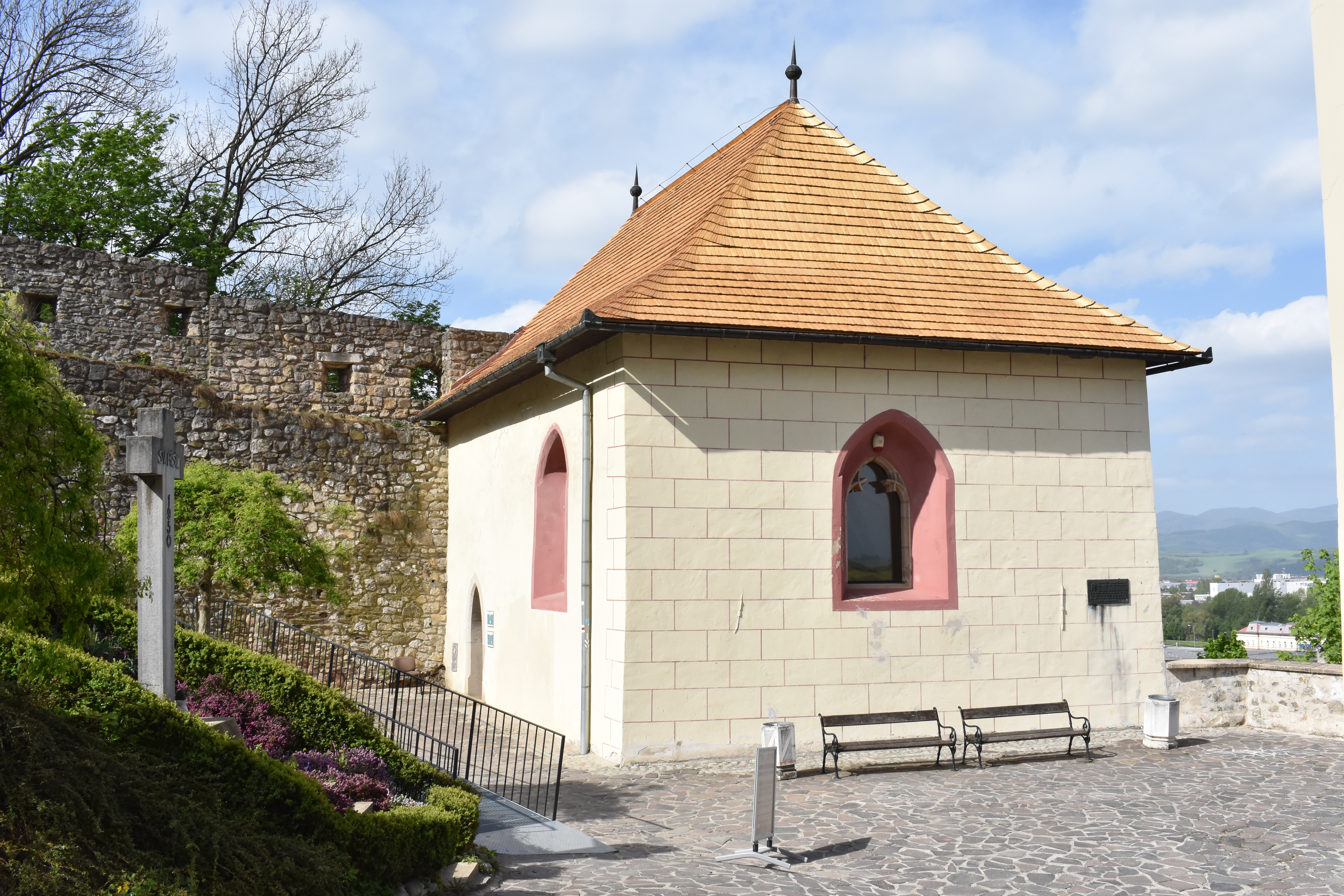
With the Castle of Trenčín it is the one substantially undamaged Gothic building in the city. The Charnel House was built in the second third of the 15th century near the Parish-Church. With its rear wall it follows towards the original town´s entrenchment. By the beginning of the 16th century today´s ground floor part, which, after the church´s fire in 1528 would serve as a chapel, was overbuilt.During 1529 - 1530 there were saved the urban invoices mentionning the reparation expenses. Until the Parish Church had been reconstructed, the Ossuary used to be the ´church´ place. In 1560 (according to the Turkish threat) it was exchanged to the town´s armoury with metal-moulding equipment in its basement. Later the building had been ruined and after the reconstructions in 1973 - 1989 it has belonged to the Museum of Trenčín.
On the area of about 70 metres square we offer a collection of sacral art from the Trenčín Museum´s collections. This not large but cogent collection combines the cross-section of fragmets from the altar complexes. A part of so-called Podlužanský altar ("TAKING OFF OF THE CROSS" from the first half of the 15th century) enables to watch the moment´s tragedy in this unique composition.Quiet and composed Madonna with little Jesus (with original polychromy) gives a persuasive evidence of former altar units quality. The torso of St. Elizabeth of Hungary (St. Elizabeth of Thuringia) is very cogent, though she misses the hand gestures so typical for Baroque style coming up. We can feel that the atmosphere of this sacral room is still dynamic and makes the surroundings vibrate. Elizabeth would be a prominent helper for the ill ones, as well as the patron of the unjustly proscribed and people suffering from poverty. She, as a daughter of the king Ondrej (born in Bratislava), died as 24 years old.
Quiet look of the "orant" would pacify the observer as if from high tones of nobility and tragedy and it would warn us to see the altar picture of St. Francis Xaver, who was the founder and general of Jesuit Order. The statues of "Francissians", looking at us from above, create up this composition. An effort to raise and let sound the energy of expressions and gestures can as well be observed at St. Francis´s pose. (He was the patron of hermits and "marriages sterile".)
The sculpture comes from the end of the 18th century.
The sculptures of St. John Baptist, who was the patron of order life, bring with their expressions a mission of loyalty and balance on the interior background of Baroque Church in Trenčín. The craftsmen had, in spite of this dynamic period, coded in their countenances peace and quiescence.
There are several fragments of sacral architecture in the niches opposite the entrance, as, for example, sculptures of gilt cherubs (putti) and a few statues of Saints, coming from the 17th and 18th century. An altar picture of St. Martin the "Bishop" from Tours closes this space and makes a pendant to the whole of the exposition. (St. Martin symbolized the patron of beggars, captives, teetotallers and other ones).
In the text and panel part you may get some more information coherent with the moved Parish Church´s history on so-called "Marienburg". From the old Church´s furniture, there is preserved a fragment of small portable altar from about 1420 and two fragmental painted altar wings from the period of about 1400, descending from the collections of National Gallery in Budapest. Their enlarged illustration can be seen on the panel.
Complete information you can get at here.